

Driving Building Energy Efficiency: 18 Newly Certified Auditors Ready to Accelerate Decarbonization

JAKARTA – For government and commercial buildings that operate around the clock, energy efficiency is the backbone of sustainability. But true decarbonization requires more than just advanced technology; it takes skilled energy auditors who can translate raw data into decisive action. Without systematic auditing, energy-saving policies risk becoming mere administrative checkboxes. This is exactly where certified auditors step in ensuring that regulations like MEMR Regulation No. 8 of 2025 translate into tangible cuts in operational costs and greenhouse gas emissions.
Rising to this challenge, the Directorate General of New, Renewable Energy and Energy Conservation (EBTKE) under the Ministry of Energy and Mineral Resources, partnered with IREEM. With support from UK PACT SUSTAINED, they recently bolstered the nation's frontline expertise through the Building Energy Auditor Training and Certification program (February 2–6, 2026). The primary focus was clear: to produce professionals capable of going far beyond basic compliance.
Eko Sudarmawan, Sub Coordinator of Technical Guidance at the Directorate General of EBTKE, emphasized that these auditors are the main drivers on the ground.
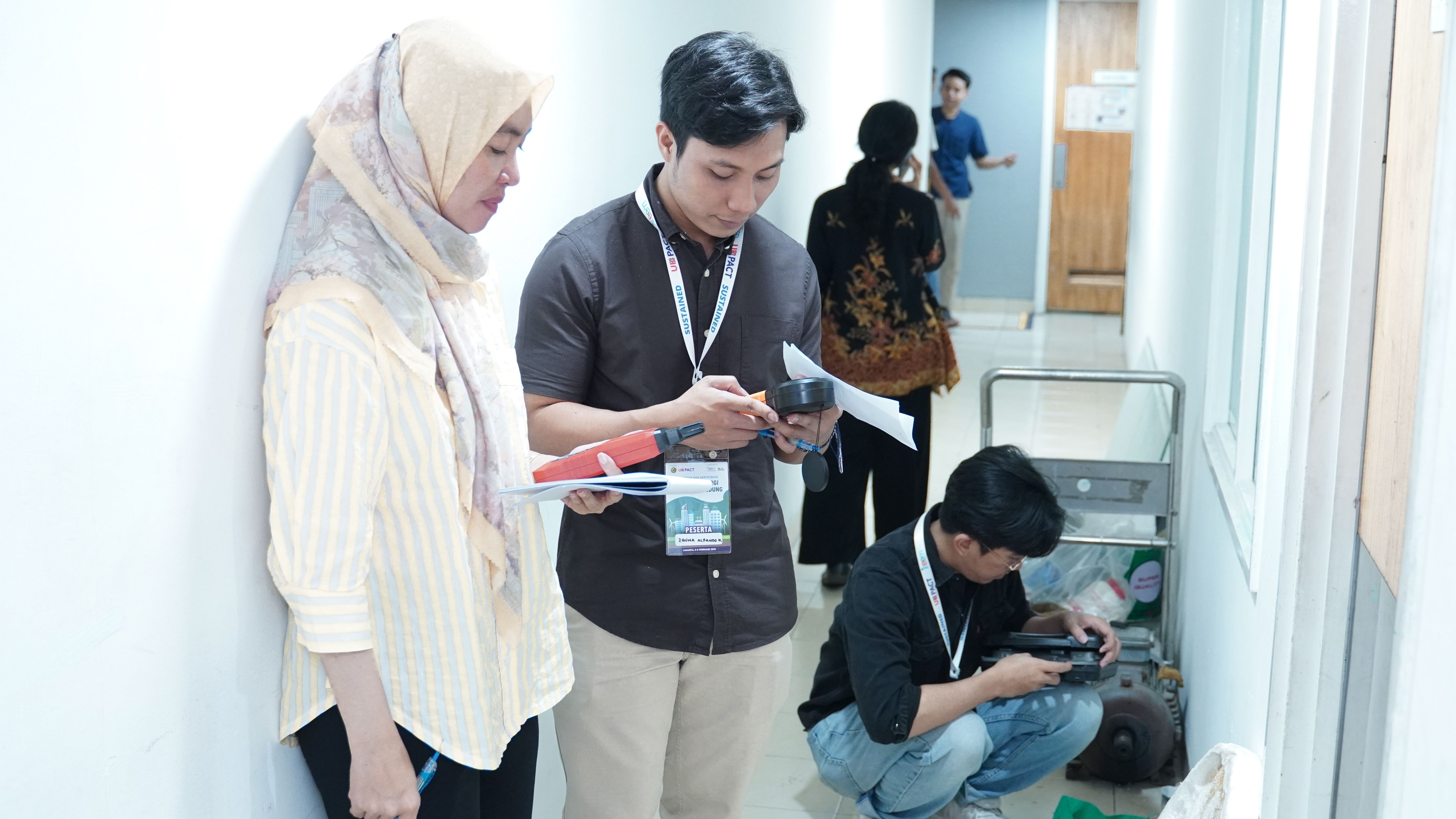
Over the course of five days, 18 professionals from diverse backgrounds spanning government agencies, real estate, university, banking, airport management company, mall, retail companies, and healthcare did much more than sit through lectures. They engaged directly in field practices, measuring energy performance firsthand and formulating highly applicable technical recommendations.
The training curriculum was designed to build end-to-end competency. It covered everything from audit planning, conducting the opening meeting, collecting and verifying data, , planning energy parameter measurements, carrying out field surveys, analyzing field survey data, and final reporting. Through this comprehensive approach, participants didn't just learn the methodology; they left fully equipped to implement it in their respective workplaces.
The program also proudly highlighted inclusivity through the active participation of female auditors. Dewi Sophiyani, one of the participants, pointed out that technical expertise knows no gender.
"As a woman entering the male-dominated energy sector, I believe that competence as an auditor has absolutely nothing to do with gender. To me, being an auditor is about integrity and capability qualities that women across Indonesia, and indeed the world, possess in abundance. Ultimately, we want to encourage ourselves and build the confidence to dive right into this field"
— Dewi Sopiyani
The certification of these 18 auditors marks a concrete step toward strengthening Indonesia’s green economy ecosystem. With routine and systematic audits, buildings now have a real opportunity to sustainably reduce their energy consumption. Ultimately, this goes beyond mere cost-saving it is a tangible, highly precise, and responsible commitment to supporting the nation's emission reduction targets.